






15 Minutes reading time
Artificial intelligence (AI) is revolutionizing many areas of our lives. But what exactly is AI and how is it used? This article gives you an overview of the basics of artificial intelligence and its most important applications in various industries.
Key facts at a glance
- Artificial intelligence (AI) includes various systems that mimic human cognitive functions and are applicable in areas such as autonomous vehicles, data analytics, and text generation.
- A distinction is made between strong AI, which simulates theoretical human consciousness, and weak AI, which is limited to specific tasks.
- The integration of AI in industries such as medicine, automotive and finance shows significant potential for increasing efficiency and optimizing processes, while at the same time ethical and societal challenges must be taken into account.
What is artificial intelligence?
Artificial intelligence, often referred to as "artificial intelligence" (AI), is the attempt to transfer human learning and thinking to computers. The aim is to develop machines that are able to imitate human cognitive functions such as learning, problem solving and decision making. Artificial intelligence AI includes a variety of complex algorithms that enable computers to find answers and solve problems on their own.
There is no single definition of artificial intelligence, but in general the term refers to systems trained through machine learning and neural networks to perform tasks that normally require human intelligence. A classic example of AI in everyday life are voice assistants such as Alexa and Siri, which are able to respond to our requests and complete tasks through natural language processing.
The applications of artificial intelligence are diverse and range from:
- autonomous vehicles
- Data analysis
- generation of videos
- generation of images
- generation of texts
It has the potential to transform many areas of our lives and create new opportunities. But before we dive deeper into the applications, let's first look at the distinction between strong and weak AI.
Strong vs. Weak AI
In AI research, a distinction is made between strong and weak artificial intelligence. Strong AI, also known as “Artificial General Intelligence” (AGI), has the potential to simulate human consciousness and to handle tasks that require broad human knowledge. This form of AI currently only exists in theory and is the declared goal of many researchers.
Weak AI, on the other hand, is limited to specific tasks and has no real consciousness or understanding. An example of this are the voice assistants mentioned above, which are able to process natural language but do not understand deeper meaning or context.
The distinction between strong and weak AI is widely accepted in society and helps to better understand the different application areas and capabilities of AI systems.
Machine Learning and Neural Networks
Machine learning is a central part of artificial intelligence and allows systems to recognize patterns in data and learn from them without being explicitly programmed. This process is based on neural networks, which consist of layers of artificial neurons. Data is passed through these layers, with weights added to improve the accuracy of the results. Machine learning is an important aspect of this process.
A significant milestone in the development of machine learning was the introduction of the perceptron, an early artificial neural network developed by Frank Rosenblatt in 1958. This model laid the foundation for many modern AI technologies and demonstrated how machine learning can be used to solve complex problems.
Since the late 1990s, machine learning has experienced a tremendous boom thanks to advances in computing power and the availability of large amounts of data. From around 2010, the application of AI technologies began to increase significantly, leading to numerous breakthroughs and new uses. These developments have laid the foundation for many of today's AI applications, which we will look at in more detail in the following sections.
History of artificial intelligence

The history of artificial intelligence is marked by significant advances and setbacks. It began in the 1950s and has achieved numerous milestones since then.
In the following sections, we take a look at the early developments, the first AI winter, and the resurgence of AI in modern times.
Early Developments and the Turing Test
A crucial moment in the history of AI was Alan Turing's 1950 paper, in which he asked whether machines could think. Turing developed the Turing Test, named after him, to check whether a computer had human-like thinking abilities. This test remains an important benchmark in AI research to this day.
Early developments in AI focused on creating algorithms that broke down cognitive processes into steps and executed them systematically. These first steps laid the foundation for the later development of more complex AI systems.
The First AI Winter
Despite the promising beginnings, AI research suffered a significant setback in the 1970s, known as the first AI winter. This period was characterized by inflated expectations and the inability of computers to handle complex tasks. Enthusiasm for AI waned, and funding for research projects was greatly reduced.
The first AI winter lasted until the 1980s and led to a general disillusionment in the scientific community. Many projects were discontinued and progress remained limited. But this was to change in the following decades.
Resurgence and Modern Breakthroughs
A new era of AI research began in the late 1990s. Advances in computing power and the availability of large amounts of data made it possible to develop and apply more complex models. An important breakthrough was the development of expert systems in the 1970s, which revived interest in AI research.
Since around 2010, AI has experienced a real boom, with numerous new applications and technologies. New system architectures, such as fingerprint-efficient software and hardware, have greatly improved the efficiency of AI systems and led to significant advances.
These modern breakthroughs have laid the foundation for many of today's AI applications and show how far the technology has come in the last few decades. In the next sections, we'll take a closer look at some of the most important applications of artificial intelligence in various industries.
Important Applications of Artificial Intelligence
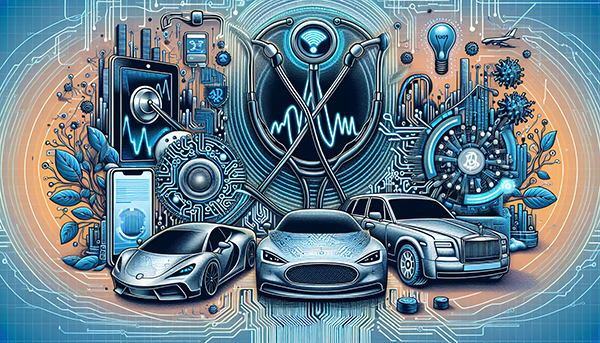
Artificial intelligence is used in numerous areas and has the potential to profoundly change our society. It is used for speech and image recognition, process automation and the development of autonomous systems. The influence of AI extends across business, education and social interactions and promises to increase productivity and efficiency in many areas.
The integration of AI into various industries could bring about far-reaching changes in the way businesses are organized and operated by 2027. In the following sections, we take a closer look at some of the most important applications of AI in medicine, automotive, and finance.
AI in medicine
Artificial intelligence is playing an increasingly important role in medicine, especially in analyzing large amounts of data to improve diagnosis and treatment. An AI system can automatically evaluate unstructured data and gain valuable insights for medical research. A notable example is Alphafold, an AI system that is able to predict the folding of proteins, which provides crucial information for biomedical research.
These advances in AI technology are helping to revolutionize medical care and improve the efficiency and accuracy of diagnoses and treatments. This is an example of how AI has the potential to fundamentally transform healthcare and open up new opportunities for biomedical research.
AI in the automotive industry
The automotive industry also benefits significantly from the integration of artificial intelligence. AI is used throughout the entire life cycle of a vehicle, from development to after-sales service. A prominent example is autonomous driving, where AI systems analyze traffic data in real time to increase the efficiency of traffic signals and reduce congestion.
In addition, AI-powered technologies such as automated parking and intelligent traffic systems enable vehicles to navigate more safely and efficiently. Sensors in the vehicle collect and analyze data to detect undesirable situations such as sudden braking and make precise decisions.
AI in the financial industry
In the financial industry, artificial intelligence plays a crucial role in automating and optimizing processes. Financial institutions use AI-powered analytics to respond more quickly to market changes and make more precise trading decisions. Fraud detection algorithms identify irregularities in transactions and report potentially fraudulent activities.
In addition, AI-powered chatbots improve customer service by handling queries quickly and efficiently. These technologies help improve the customer experience through personalized services and automated care. AI enables financial institutions to better manage risk while increasing the efficiency of their services.
Artificial Intelligence and Society
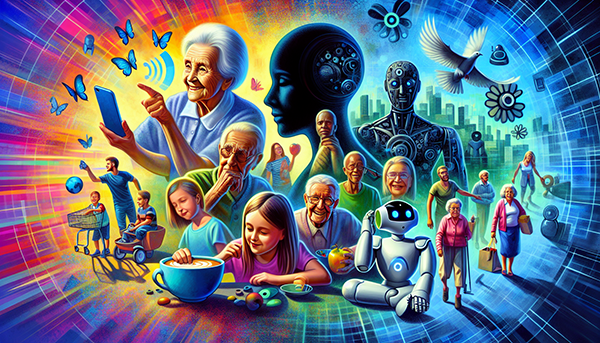
The impact of artificial intelligence on society is far-reaching and complex. AI influences almost every area of life, from jobs to ethical issues to data protection problems. While only six percent of small and medium-sized enterprises (SMEs) in Germany currently use AI technologies, this shows the considerable untapped potential that lies in this technology.
In the following subsections, we will look at how AI is changing jobs, the ethical issues and data protection, and the necessary regulation and policy measures to ensure responsible use of AI.
Workplace Changes Through AI
It is estimated that up to 300 million jobs worldwide could be automated by AI, including in knowledge-intensive occupations. This poses a huge challenge for companies and employees who must prepare for these changes. Companies must prepare their workforce through training and adaptation measures to integrate the new role of AI.
The adoption of AI can both require new skills and make existing skills obsolete. Small businesses should consider the potential effects of AI on increasing revenue and reducing costs as an important consideration when implementing it. It is critical that companies and employees prepare for technological change to take advantage of the opportunities offered by AI and minimize the risks.
One example is the need for workers to acquire new digital skills to remain competitive in an AI-driven world of work. This could be achieved through targeted training programs and lifelong learning to facilitate the transition to the new world of work while strengthening companies' innovation and competitiveness.
Ethical Issues and Data Protection
Ethical challenges related to artificial intelligence include data breaches and the need to protect personal information. A significant problem is bias in the data, which can lead to discriminatory decisions, as shown by the example of Amazon's AI that only selected male applicants.
The term 'black box' for AI results from the complexity of its internal processes and the difficulty of understanding decision-making. To avoid discrimination and misuse, responsible use of AI in important areas of society is essential.
Regulatory approaches must ensure that ethical standards are maintained while encouraging innovation.
regulation and politics
Policy and regulation play a critical role in guiding the development and use of artificial intelligence. Regulatory approaches must be flexible and adaptable to keep up with rapidly changing technologies. Flexibility in regulation can ensure that advances in AI are managed responsibly and ethically.
The European Parliament and other political institutions are working to create frameworks that both protect citizens and promote innovation. The challenge is to find a balance between these two objectives and ensure that the development of AI technologies is in line with ethical and societal values.
Future Trends in Artificial Intelligence

The future of artificial intelligence is full of exciting opportunities and challenges. The rise of generative AI requires a reassessment and possible adjustment of existing intellectual property rights. Generative AI may inadvertently disclose sensitive information, which can have serious legal and trust implications.
In the following subsections, we will look at three major future trends: multimodal systems, advances in robotics, and the development of super AI and singularity.
Multimodal systems
Multimodal systems are a promising trend in AI development. These systems can process image and text data simultaneously, enabling more comprehensive data usage. By integrating different types of data, AI systems can be trained more efficiently and deliver better results.
Future AI systems could become even more powerful by combining data from simulations and real-world experience, opening up new possibilities for developing smarter and more versatile applications in various fields.
Advances in Robotics
The combination of artificial intelligence and robotics enables innovative applications in various fields. Advances in robotics combined with AI lead to systems that are able to perform physical tasks autonomously and interact directly with their environment.
The vision of Super AI implies a form of AI that can continuously expand its own knowledge and capabilities. This development could lead to groundbreaking innovations and fundamentally change the way we interact with machines.
Super-AI and Singularity
The stated goal of many AI researchers is to develop a strong AI that can perform human-like tasks. A further development of strong AI is super AI, which can improve itself and optimize its own algorithms. This super AI is on the verge of its big breakthrough and could revolutionize the way we use technology.
The boom in artificial intelligence began with the ImageNet breakthrough, which impressively demonstrated the performance of modern AI systems. Research into super AI aims to develop systems that can continuously improve and adapt their own algorithms to handle increasingly complex tasks.
The development of super AI could lead to the singularity, a point at which AI systems become so advanced that they surpass human intelligence. This prospect raises numerous ethical and societal questions that need to be addressed to ensure that this technology is used for the benefit of humanity.
AI in small and medium-sized enterprises
Artificial intelligence also offers significant benefits for small and medium-sized enterprises (SMEs). AI can perform tasks better than humans, reducing the error rate and increasing efficiency. By analyzing consumer data, personalized products and services can be offered that increase customer satisfaction.
AI-powered systems can generate automatic orders for missing items, optimizing inventory management and reducing costs. In the following subsections, we will look at the first steps to implementing AI and successful practical examples.
First steps towards implementing AI
When implementing AI, companies should think about how AI can increase their revenue or reduce costs. The quality of the data and the corresponding knowledge are crucial to the success of an AI project.
In Germany, the Mittelstand 4.0 centers offer free information to gather knowledge about AI and facilitate implementation. Companies should check which data is already available and which could still be collected in order to create a sound basis for AI applications.
These preparatory steps are crucial to fully reaping the benefits of AI technology.
Examples of success from practice
Artificial intelligence can take over monotonous and repetitive tasks, allowing employees to focus on more creative and value-adding activities. New AI business models could create new jobs in SMEs, increasing innovation and competitiveness.
According to a study by the University of Oxford, 47 percent of all US jobs are at risk from automation, which highlights the need to prepare for technological change. AI is increasingly being used in SMEs to optimize processes and work more efficiently. Successful practical examples show how AI can strengthen the competitiveness and innovative strength of companies.
Summary: Key takeaways about intuitive eating
Artificial intelligence has made tremendous progress in recent decades and is now an integral part of many industries. From medicine to automotive to finance, AI is revolutionizing the way we work and live. The history of AI is marked by significant milestones and setbacks, but modern breakthroughs show that we are only at the beginning of this exciting journey.
The future of AI promises many exciting developments, from multimodal systems to advances in robotics and even super AI. It is imperative that we overcome the ethical and regulatory challenges to ensure these technologies are used for the benefit of humanity. Let us seize these opportunities and together shape a future where AI makes a positive contribution to our society.
Frequently Asked Questions
What is the difference between strong and weak AI?
The difference between strong and weak AI is that strong AI is able to simulate human consciousness and handle versatile tasks, while weak AI is limited to specific, defined tasks and lacks true consciousness or understanding.
How does AI impact jobs?
AI has the potential to automate up to 300 million jobs worldwide, creating a need for new skills and adapting existing ones. Companies must therefore implement targeted training measures to prepare their employees for these changes.
What ethical challenges are there in using AI?
Ethical challenges in the use of AI particularly concern data protection violations, biases in the data and the lack of transparency in decision-making. It is essential that regulatory approaches ensure compliance with ethical standards.
What are multimodal systems in AI?
Multimodal systems in AI are able to process image and text data simultaneously, enabling more comprehensive data usage. By combining data from simulations and real-world experience, they improve the efficiency and performance of AI applications.
How can small and medium-sized enterprises (SMEs) benefit from AI?
Small and medium-sized enterprises (SMEs) can increase efficiency and reduce error rates by using AI. In addition, the analysis of consumer data enables the development of personalized products and optimization of inventory management.